Week 4 – August 3, 2025:
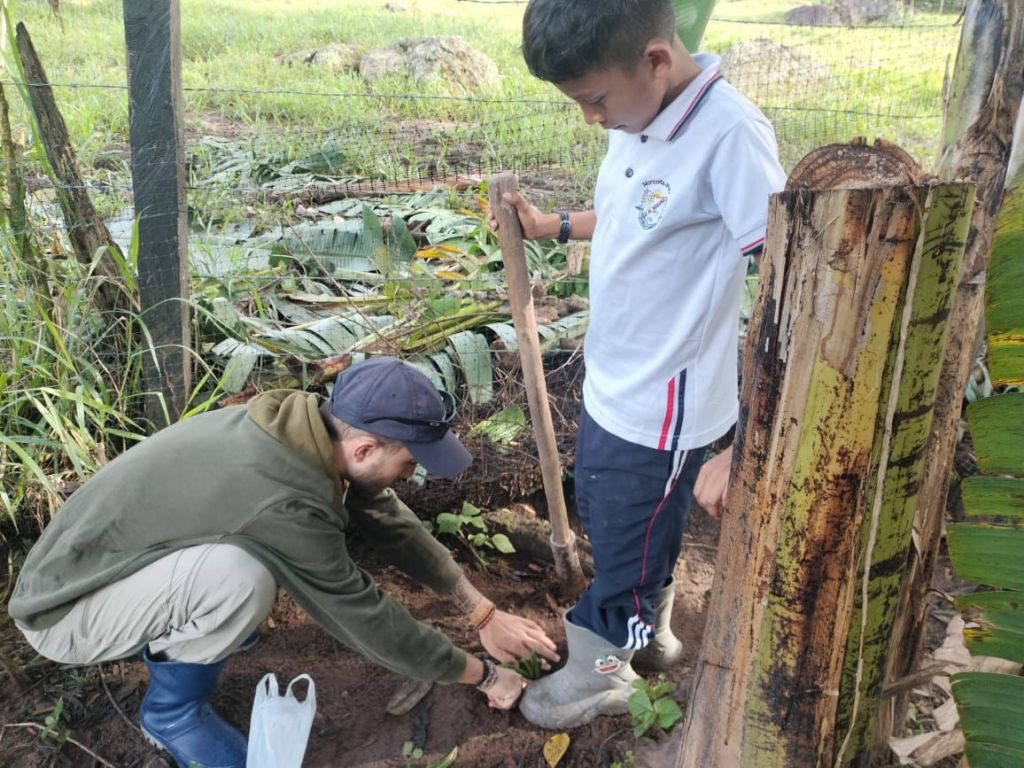
We start the week with gardening. A representative from the municipality brought seedlings to plant. He gives us a quick lesson on how to put them in the ground, the distances needed between each plant, etc. We spend the morning planting, weeding, basically gardening. Among the seedlings, we planted lettuce, beets, parsley, onions, and other foods that I don’t know. We’re all tired from this morning’s activities, so there’s no class this afternoon, and we finish early.
I continue my classes, focusing on English while slightly neglecting French as August is approaching! I need to check with the NGO coordinator when I will change schools. Therefore, I’m trying to do my best to ensure the students speak at least some English before my departure. On Thursday, the older students don’t have class. Their teacher is supposed to work at the college with the principal. I don’t even mention the substitutes, to the point that they do not exist. I spend the morning with the younger kids, and in passing, we have a gardening session again because a bull managed to enter the vegetable garden and trample the plants. Just before lunchtime, Teacher Miguel asks me if I want to go to the village to make an intervention for a special day at the college. It’s last minute, but it can be done. I pack my bag, inform Doña Rosa, and then we take off on the teacher’s motorcycle. An hour’s drive through the mountains, the jungle, crossing streams and landslides… I had already experienced it last week, but every day the two teachers from Milagros embark on a journey to come here! He shows me where some of the children from the school live, those who have to walk between 1 and 2 hours to come and the same to go back. Sometimes on horseback, it’s a bit quicker, but there are days when they cannot come because their parents need them to work or simply because the road is impassable. Given the torrential rains we have almost every day, we understand completely. We continue our journey with the teacher. Oh, the brakes have failed. He doesn’t seem too worried about it, so there’s no reason to worry. I must mention that we are obviously without helmets. Well, we arrived safe and sound in the village. Miguel lets me stay at his house since he is away for the weekend (the little ones don’t have class this Friday, I don’t know why). I take the opportunity to take a tour of the college to talk with the principal concerning the day for tomorrow. She explains to me that essentially it’s a sports award ceremony and the best of each level. But then, what am I doing here? I will do a short interview in English with a teacher and then I’ll speak to introduce myself, briefly talk about the countries I have visited, and the principal insists that I stress the importance of learning languages and studying at school (it is well-known that I have an impeccable academic background). Basically, the idea is to show that the world is vast and that they are not required to stay in their village their entire life. Because here, people only know their valley and their village, and to put it simply, they are born, live, and die in the same place.
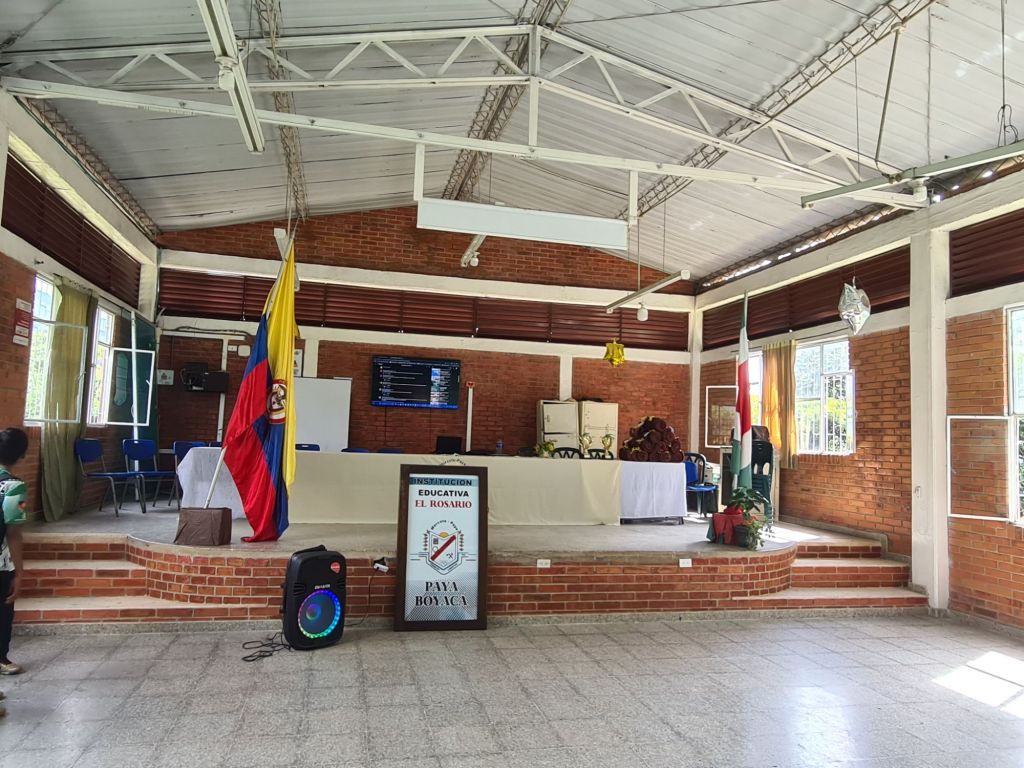
I arrive at the college at 7 a.m., with my speech all prepared (not at all), but, Colombian organization, the award ceremony starts around 10:30 a.m. So I wait. I give a little English lesson to 5 students who were also waiting. Then comes the time for the ceremony! I help set up, and all the students from the college arrive and line up. There are about 80 of them, and it’s strange to see so many children in one place! The ceremonies are very formal though. We start with the Colombian anthem (by the way, it’s very beautiful), then the anthem of Boyacá (the region), and finally the anthem of Paya (the municipality). True to its reputation as a musical country! And we don’t joke around with the anthems: everyone has their hand on their heart and sings! After that, there’s some speaking at the microphone (I admit I don’t listen too closely), awards are handed out, and then comes the moment of the speech! Faster than a train passing through the station without stopping. I then take the mic and make my little presentation, in Spanish, please; I see surprised looks when I say a few words in French or English, then we finish the ceremony with more awards. At lunchtime, I’m surrounded by a horde of curious middle schoolers wanting to hear me speak French, English, or Italian! They ask me plenty of questions: where I’m from, Messi or Ronaldo?, what do we eat in France?… The lunch break is short, and they go back to class, which will finish around 2 p.m.
To get back to Milagros, it takes me between 5 and 6 hours of walking. The weather is nice, the sky is blue, and I’m warming up for now! I grab my things and I’m off into the jungle. The journey goes smoothly, with no rain, and with a lot of luck as I encounter a family of monkeys jumping from tree to tree. There are about 5 or 6 of them, and I stay for a good while to watch them move with impressive grace. A little later, I come across another group of monkeys! More easily observed, they are not very big and wear black and white fur. I am so happy! Two families of monkeys on my path! But the day isn’t over yet, and amidst the stunning landscapes, the mountains at sunset, the atmosphere that reigns on this road, I spot a toucan! An emblem of South America, it flits from branch to branch above me. The rest of the walk will be in the company of thousands of birds of a thousand colors and butterflies more beautiful than the others. I arrive at the house lit by the moon, singing.
I don’t have time to take off my boots before they rush at me and inform me of three surprises. I’m scared. Surprise number one: a turtle. They found it in the mountains and brought it back. Why not? Surprise number two: a new dog. She was abandoned and they took her in. That’s cool! Surprise number three: a baby monkey. What the heck? One of the kids bought a baby monkey. That’s a surprise! At first glance, I’m not a fan at all. Having a monkey tied up all day seems awful to me. A monkey is meant to jump from tree to tree in the jungle. Apparently, it was rescued by a neighboring family who found it alone. Well, that makes sense. I’m having a bite to eat and then going to bed. I will develop the treatment of animals next week, once I see the fate of the newcomers.

Week 5 – August 10, 2025:
We start the week slowly: Monday, Tuesday, and Wednesday are school days. An average day? Wake up between 5:30 and 6:30 AM, first tinto of the day. Tinto is Colombian coffee prepared with panela (hard cane sugar). Then I have a second tinto. Then a third… No, not really. We wake up gently and then have breakfast together, accompanied by a tinto.
Meals vary, but I will try to be as precise as possible. For breakfast, it can be a soup with a plate of rice accompanied by bananas and yuca (a white tuber), pasta, potatoes, and arepas (a biscuit made of corn flour; there’s nothing more Colombian than arepas).
To try to describe the meals here, it is essential to take into account that the plates always consist of several ingredients/dishes. For example: rice, banana, yuca, and eggs. Or rice, lentils, yuca, and salad. Or pasta, rice, yuca, and eggs. The foods that are found at every meal are rice, yuca, and eggs (for me, the others are just meat or fish). A significant difference I’ve noticed is that we never drink water here. In fact, we hydrate ourselves with soups, tinto, homemade fruit juices (served at every lunch), homemade lemonade (which we drink throughout the day), agua panella (hot water with panela and herbs), hot chocolate (made with water), and for adults, beer, but I will return to that later.
Let’s get back to the point. After filling up our stomachs, we head to school because classes start at 7:30 AM. We live just next door, so we obviously leave at the last minute. The teachers arrive between 7:20 and 7:45 AM, depending on how much it has rained and the condition of the road. Just to remind you, it’s a 1-hour motorcycle ride for them.
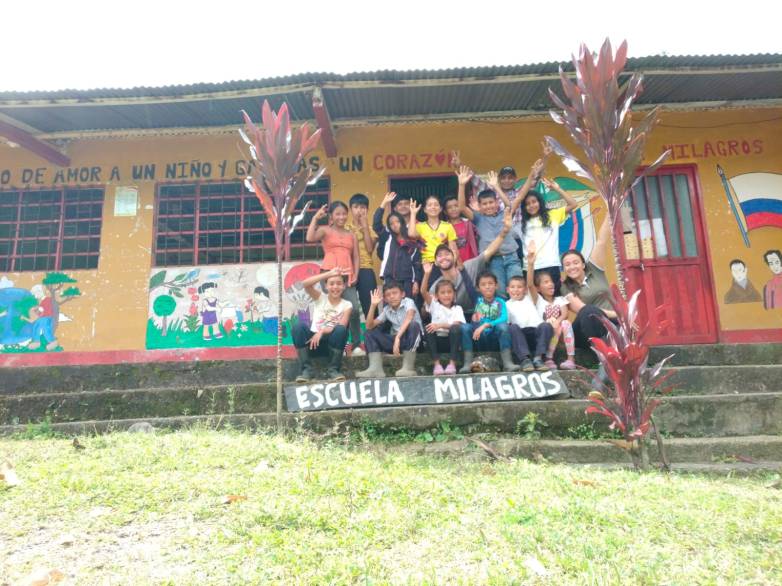
When we enter the classroom, we say the « oración, » the Our Father. I want to clarify that it’s a public school, but Colombia is a very practicing Catholic country. Generally, I spend the first part of the morning with the youngest kids, about 5 students when they all show up. I conduct an emotional activity, followed by 30 minutes to an hour of English, depending on their attentiveness. The emotional activity is part of a mini project from the organization that provided me with a document containing about twenty activities on emotions, ecology, and their dreams. The English lessons mainly focus on vocabulary: days of the week, months, animals, family, the body… After a month, some still haven’t memorized the days of the week, which is a bit discouraging. So we stick to the very basics. But as the saying goes: « There are no bad students, just bad teachers. » Sometimes we have a very basic French lesson, but I prefer to prioritize English. To be honest, it has been tough to realize they retain nothing. But I dare to hope that a few traces will remain. Around 10 a.m., it’s recess! We have a snack of bread + eggs or rice pudding + fruit or arepas or something similar. We eat calmly and then go play soccer, the national sport in Colombia, enjoyed during every free moment at school. I must admit they have a very good level. They all play together, both big and small, girls and boys. It’s quite different from recess in France. After that, we return to class between 10:30 and 11, depending on their motivation. At this point, I go to the older kids, the 10 little ones (when they are all there). Sometimes they are busy with a subject, so I hold class in the afternoon, depending on the day. Anyway, when I’m with them, I start with the emotional activity and then English. Similarly, I have conducted a few French classes, but I focus on English. Now we are really working hard. Alphabet, introductions, family, forming simple sentences, conjugating in the present tense, present continuous, asking questions, and answering them. Basically, that’s what we have covered in a month and a half. Their baseline level was a few vocabulary words here and there; I don’t place the blame on the teacher because from what she told me, she isn’t a teacher by profession, and she is doing her best to teach. I might be a bit boastful, but I like to believe that I’ve inspired a few students to continue learning English. I know for some it’s not a priority, and that’s okay, but for those few motivated students, I understand better the passion some teachers have.
At noon, it’s lunch break. All the kids and teachers go to eat in the cafeteria, and I go back home. Typically, it’s rice + beets/carrots + lentils + yuca and eggs. Like at breakfast, it varies: sometimes pasta, arepas, or salad. All of this comes with lemonade or juice. I return to school by 1 PM, and the students come back around the same time. As I mentioned, the afternoons are either spent with the older kids or preparing upcoming classes and activities. Classes end at 2 PM for the little ones and around 3 PM for the older ones, except on Fridays when they finish an hour earlier. When it rains heavily, they finish earlier due to the travel needed for some. The afternoons are chill; we go home to relax, have coffee, sometimes go swimming, play football, play Kems (I taught them the card game), or I read. Every day we wash in the stream next to the house. We’ve set up a pond there, and it’s super comfortable! We have dinner between 5:30 PM and 6:30 PM, often play a few rounds of Kems, and around 7:30-8 PM, we go to bed. A little evening meditation and reading, and by 9 PM, it’s lights out! That’s a typical day at Milagros!
Then Monday, Tuesday, and Wednesday are quiet days, then Thursday is a public holiday. I didn’t understand why, but in any case, there will be no classes. In the morning, we gathered the herd, and in the afternoon, it’s swimming in the river with other children. They bring their fishing lines and often catch small fish that end up in the pan for dinner. And Friday is a special day: it’s el día del campesino, which would translate as a village festival but throughout the region. The day before, the men weeded the entire school (because it takes place at the school), built a shelter to make a fire, and brought back the cow that will feed everyone.
The day dawns slowly, around 5:15 a.m., when suddenly the commotion begins. They’re going to kill the cow! There’s excitement in the house, everyone gets dressed to go and watch the show (maybe not the right word, but anyway). I stay warm in my duvet, but around 6 a.m., I’m wide awake, so I might as well go see the killing. Unfortunately (or perhaps fortunately), I arrive too late and can only watch the animal being butchered and its organs being removed from its body. What a way to start the day!
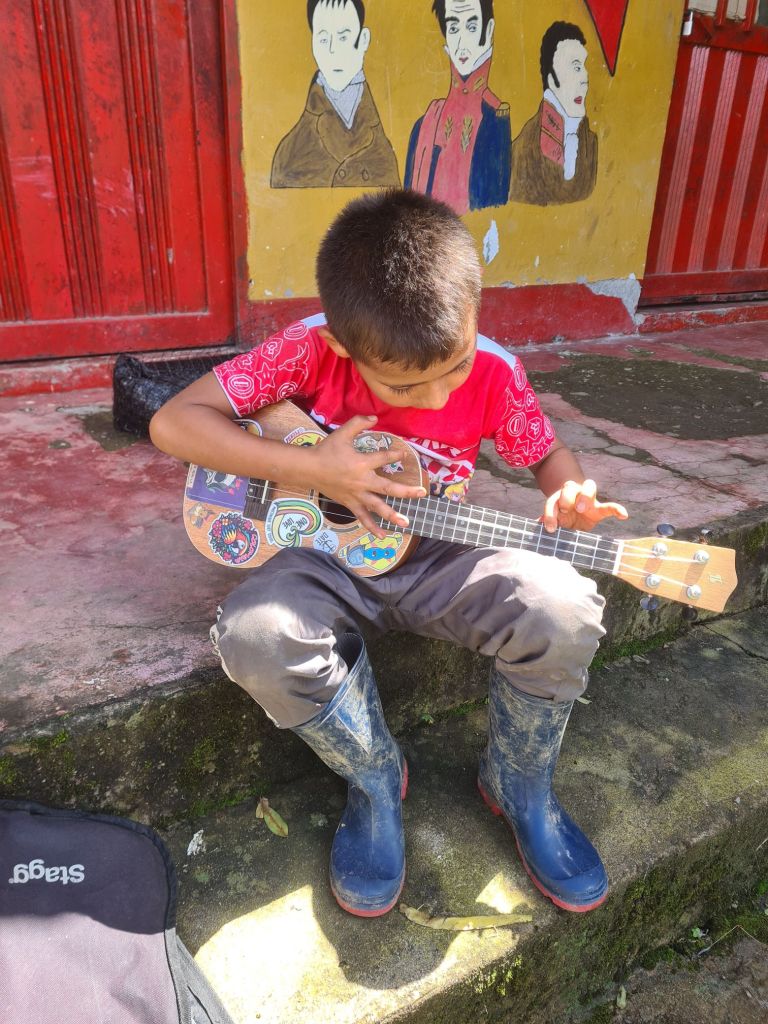
The party starts around 10 a.m., when most people have arrived. The games will begin with prizes planned for the participants. Among the games, there is a race for seniors (only people over 60) who have to chug a chicha, a fermented corn alcoholic beverage. The best lumberjack competition is almost like the show but better. There’s a soccer match (which I will win with my team). It’s festive, it’s great! The cow is then shared with everyone (except for a little French kid who doesn’t eat meat), and then it’s prize-giving time! Each winner receives a prize for their participation (a towel, kitchen accessory, clothing), and each family gets a machete and a blanket. The municipality treats everyone. And every person present also gets a pair of Crocs. We end the party under torrents of rain that came out of nowhere, but it remains a beautiful day. The weekend goes by peacefully; we take care of the herd, play soccer, Kems, a lot of reading, ukulele, and coffee. In about a week, I will leave for La Unión, a small hamlet in a neighboring valley (a 2-hour walk from Milagros)—changing houses, changing schools, changing students, just something new! I can’t wait to see all of this.
Week 6 – August 17, 2025:
It’s been a week of life and death! It started on Monday with the death of a dog in the schoolyard. When we arrived at school, we saw him walking with difficulty, and then at 10 a.m. break time, he was lying lifeless, eyes open, near the soccer field. The teachers asked the students to notify the owner so he could come and remove it, but spoiler alert, he never came. We buried it on Wednesday because the smell was awful. It was a rainy funeral. We dug its grave with the children, then with 3-4 older kids, we put it on a piece of sheet metal that was lying around and laid it to rest in its final resting place. From an outside perspective, it’s hard to see a dead body for children (the youngest of whom are 6 years old). But here, I feel like death is part of everyday life, and above all, they mustn’t show the slightest weakness. This is El campo (the countryside) here; you have to be strong and take it in stride. So we bury him, and after a few words and some flowers, we go back to class. We now have a grave in the courtyard for a dog, which shows how animals are treated here. Useful for a while as a guard dog or for hunting, but once too old, too weak or sick, they are abandoned. The dog in question was terrifyingly thin and sick, as you could see spots of infection or mold on its body.
On Monday night, just as we were going to sleep, we were awakened by a noise outside: something had collapsed. We all got up to see the source of the noise. It didn’t take long to find: a landslide by the river. One must avoid being in the wrong place at the wrong time. The next morning, after daylight, we will see the extent of the landslide, and it was no small matter. Landslides like this happen every day in the area, mainly due to the rain.
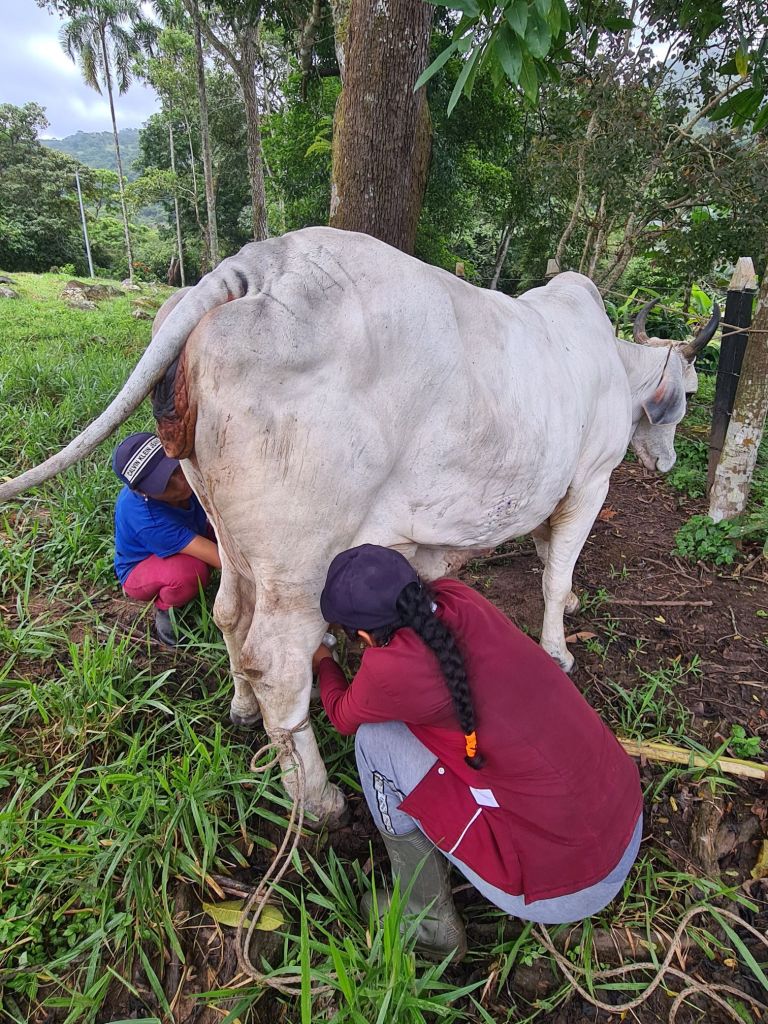
Great news! Jaimito (the baby monkey) is going to a sanctuary! After discussing with Céline (the NGO coordinator) and Andrea (the association coordinator), Jaimito should be leaving soon for a place where he will be better housed, fed, and hopefully with other companions. It hasn’t been an easy moment as it’s a bit « my fault » that the monkey is leaving since I was the one who told Céline that there was a monkey at home. But he will be much better there. After death comes life! Thursday brings the birth of a calf! We haven’t decided on a name yet; it’s still under discussion. Where there’s a calf, there’s milk, but to get the milk you have to milk the cow. It was my first milking experience. I’d say I did well because we got some milk. However, what I didn’t know is that in the first week after a calf’s birth, the cow produces yellowish milk, rich in nutrients to help the calf gain strength. This milk is then cooked and either drunk or eaten (strange consistency). I tasted it, and I don’t think it’s amazing. But the kids love it here. We also help the newborn learn to suckle because he’s a bit clumsy, I would say. A weekend spent getting to know the cow, but it’s cool!
I discussed with Céline and the school change is scheduled for Wednesday afternoon. We are entering the second half of the volunteering: after a month and a half at Milagros school, I am changing valleys to go to La Unión. During my excursions in the village, I had the opportunity to talk with the director of the college, and after some discussion and organization, I will go to the village two days a week to help at the college and in the surrounding schools. On Monday, Tuesday, and Wednesday I’m at La Unión, then Professor Miguel will pick me up and drop me off in Morcote until Saturday when I will walk back (about 3 hours of walking). So that’s the information. On Saturday morning, we went up into the mountains to see the herd and conduct a “water” operation because there is no more water for the cows. It was a 5-hour round trip, and a good part was like « Indiana Jones, » using a machete to clear the path. It wasn’t the safest route, but we made it through. Then on Sunday, we recorded a video with a student’s father where we played the ukulele. I believe it’s for his TikTok.
Next step: The Union!
En savoir plus sur Les aventures de Cécé
Abonnez-vous pour recevoir les derniers articles par e-mail.

 Les aventures de Cécé