I quickly board the Victor Manuel (it’s a boat, you know) and we set off right away. For this crossing, I’m the only foreigner on board. There are quite a few of us, but a large part will disembark at the first town. It’s a short trip: 2 nights on the cargo ship. So I stay relaxed on the boat, trying to walk a bit to stretch my legs, but the space is limited. Meals are included and served at the table! Or rather in the hammocks. I donate my chicken or another piece of meat to my neighbors and finish my little plate. As our dear former president would say: “it was tough.” Nothing special happens during the day; the boat makes multiple express stops to unload and load tons of bananas. The boat is maneuvered with speed and efficiency.
Although having seen it on the previous ship, the Peruvians throw their waste overboard. Organic and plastic. But this was on another level: a crew member of the boat outright emptied the deck bin overboard. I pointed it out to him, but well. It’s all the more sad since many people use the Amazon water for washing, cooking, fishing, and even drinking. Unfortunately, in Peru especially, there is no waste collection (or very little), no education regarding pollution and waste, and of course, plastic is ubiquitous. This leads to a country (the northern part) overwhelmed with waste. It’s the second night on board, and we arrive at the shores of Santa Rosa, in Peruvian territory. I slowly make my way to the immigration post to exit the territory. I then cross over to Colombia, in Leticia. I’m still hesitating whether to stay a few days here for the carnival or to leave directly. I roam around the Colombian side, then decide to inquire about boat departures to Manaus. I then cross over to Brazil, in Tabatinga, and I directly enter the territory at the immigration services. Once at the port, I learn there is a boat in one hour to Manaus. Let’s go, we leave right away. A little adventure with a taxi to withdraw money, and I board the Sagrado de Dios. I go up to the top floor and find several Europeans/travelers who had the same idea. We all settle in and quickly get to know each other. Let me introduce you to the awesome team with whom I will navigate to Manaus: Marion and Melissa, French, Ismael and Lou, French, Save, Italian, Martina, Uruguayan, Sarah, Australian, Sofian, Dutch, a couple from Argentina, and some Chileans. This entire little group consists of travelers, and most will head to Rio de Janeiro for the carnival.
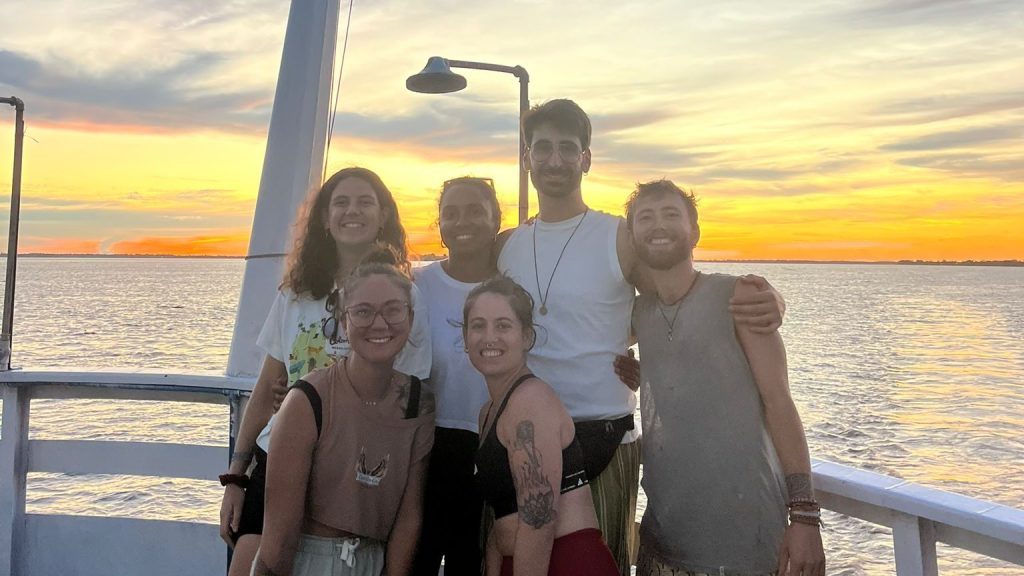
Meanwhile, here we all are in the same boat. To accompany us, I would say there were about 200 more people on board, crammed together in hammocks. The boat is much larger than the previous two: as I mentioned, more people, more toilets (wow), a free drinking water dispenser, a small terrace with a little tienda that mainly sells beers and snacks. On the boat, meals are included: breakfast at 6:30, lunch at 11:00, and dinner at 5:00 PM. This doesn’t change much for me. We lift anchor at 1:00 PM, but we quickly make a stop to board more people and goods. The real departure will therefore be at 4:00 PM. Note that we advance one hour to align with Manaus time.
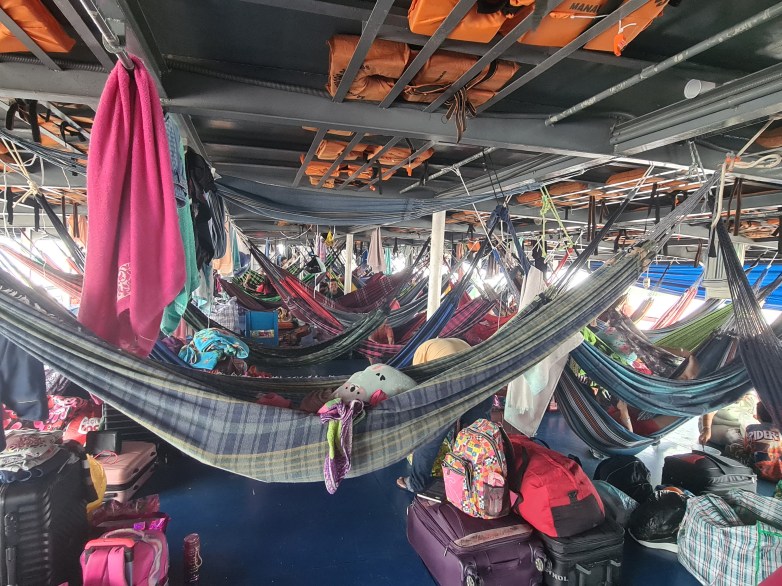
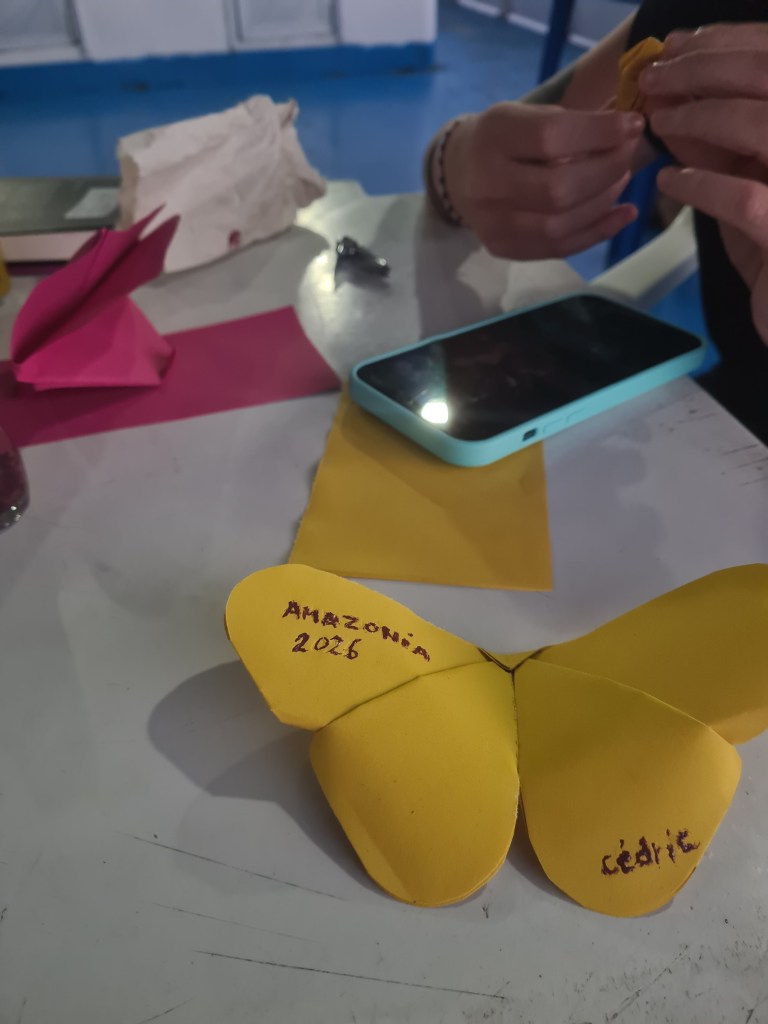
Life on the boat begins slowly; we settle in, doing laundry for me, and quickly move to the terrace, the friendly gathering place on the boat. Days pass quickly on board. I spend a lot of time making bracelets on the terrace, which has led me to sell a few and teach my friends how to make them. Life is punctuated by the sound of the bell announcing mealtimes. It’s not five stars, but we’ve seen worse. Rice, pasta, and red beans at every meal for me, with chicken or beef for the others. That’s for lunch and dinner. In the morning, it’s super sweet coffee, a small meat sandwich, and pieces of cake. We practice bartering with other passengers. Save will hold a yoga session on the last two evenings, under the surprised looks of other passengers. Another little ritual that quickly formed is playing cards with a refreshing beer at sunset. We all gather to chat, enjoy the sun fading into the jungle, and, as I was saying, to quench our thirst.
It was a bit like a summer camp on this boat, but it was great! We arrived in Manaus three days later in the evening. Some booked a hostel near the port, while others opted for a private apartment to rest, so the group split up. But to finish in style, we all disembarked with our big turtle backpacks, and here we were in the streets of Manaus by night. Each small group headed to their accommodation. So I went to a hostel with Save, Marion, and Melissa. The girls and I would explore the city and do some shopping the next day. The city isn’t amazing, so I won’t dwell on it.
As I mentioned earlier, the majority of the group is heading to Rio to celebrate Carnival, so I have no doubt they will see each other there. I, on the other hand, am continuing my journey towards the Atlantic!
I’m heading back on a boat towards Santarem, a bit further along the Amazon. This time, no strangers on board. Just loud music all day long, but hey, it’s carnival season. I spent most of the time reading in the hammock or on the deck during this journey. About 30 hours by boat, and here I am in Santarem! I find a hostel to spend the night, then I head out for a bite to eat and a stroll along the pier. The next morning, at breakfast, I meet a small family (grandparents, daughter, and grandson). They are really nice; we chat while eating, and then they invite me to join them at the beach. Let’s go!
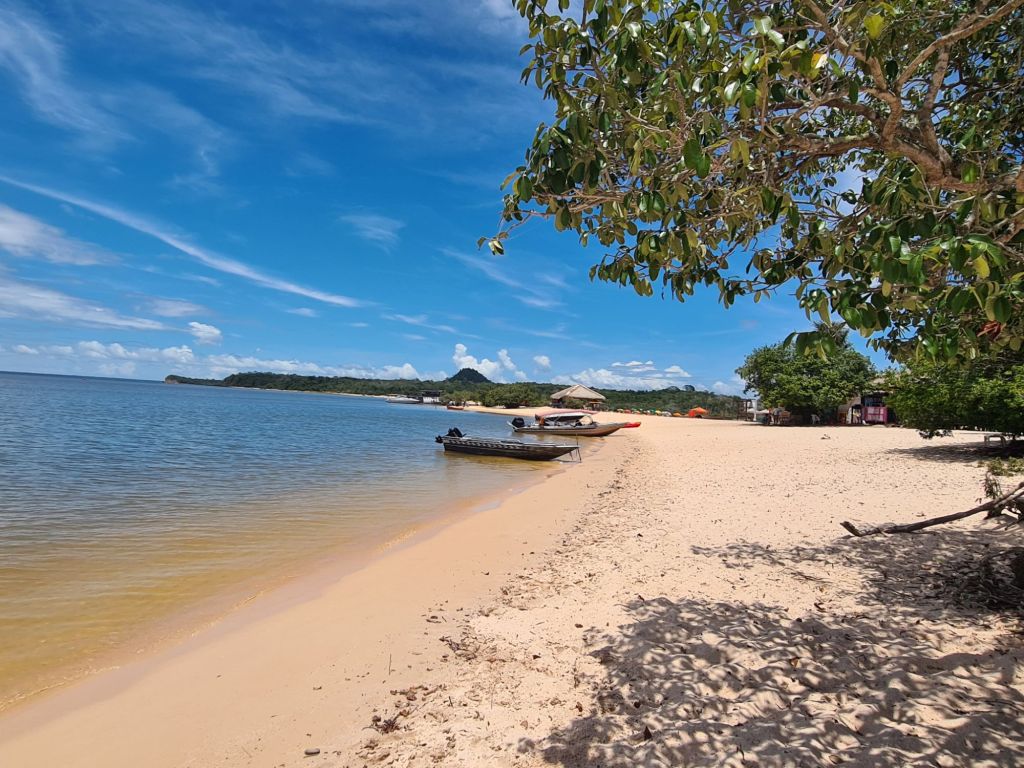
We spent the afternoon enjoying a small beach with an uncle who joined us. I don’t understand everything that is being said, and as for responding, I won’t even mention it. Basically, Portuguese is like an Argentine Spanish with pronunciation and words that vary. I then head toward Alter do Chão, a small village nicknamed « The Little Caribbean of the Amazon. » Barely getting off the bus (I was hitchhiking when the bus passed by, so no, I’m not a purist about hitchhiking), I knock on the doors of a hostel offering my services for a volunteer position. Luckily, the second hostel I ask accepts! I start tomorrow afternoon at 5 PM. For now, I drop off my bags and head to the nearby beach to enjoy the sunset. I have to say, the village truly deserves its nickname: fine sandy beach, reflection of colors on the blue expanse at the horizon, warmth… In short, we are doing well here.
The next day, I start my volunteering in the afternoon. On the agenda is greeting any guests that show up, setting up breakfast, and that’s it. It’s not too complicated after all. I will take this time to cook some nice dishes, write, study my Portuguese lessons, and of course, update this wonderful blog (with new photos in the gallery!) A few days later, I’ll set up a small table in front of the hostel to sell my bracelets and stickers, but with the tourist season at its lowest, sales haven’t taken off. The idea of volunteering here is to 1) learn a bit of Portuguese and 2) enjoy the incredible environment. Every morning, I take out my notebook and follow my lessons on YouTube and Duolingo, and with Sandra, the owner of the hostel, I can practice what I learn. I quickly pick up specific words in Portuguese. But overall, as I mentioned, it has a strong base in Spanish. Every day, I also cook, as I missed being in the kitchen whipping up good (or not) dishes. A trip to the beach is a must every day to cool off during the day and to admire the sunset some evenings.
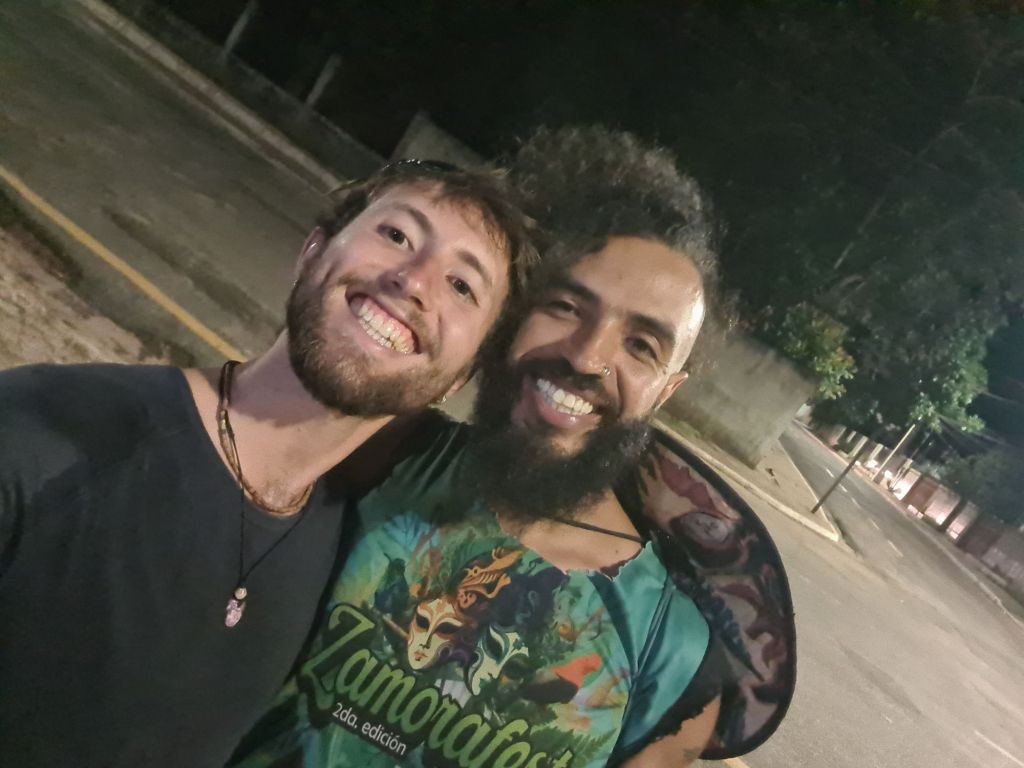
A few days after my arrival, while I was going grocery shopping, I bumped into a guy who said something to me, and I had the impression of knowing him. I went over to him, and I wasn’t mistaken: it’s Jay! Who is Jay? For the more diligent readers, he’s a Colombian who lived in a castle in a park in Loja, Ecuador. We had met him with Eva and had a little training session together. What a small world! We celebrate our reunion over a mate and chat about our journeys to get here. Jay is a traveling artist: he makes a living by performing small street shows. He is also broke. But that doesn’t stop him from being a good mate! From then on, I spend a few afternoons with the whole gang of artists (who mainly sell jewelry) hanging out in the main square. They all speak Spanish, so I won’t be practicing Portuguese with them, but that’s okay. We chat, make bracelets, drink mate… The little troupe is really nice!
During my stay in Alter do Chão, I will have the opportunity to take a sightseeing tour at the Jari canal. First stop will be at a community to see animals: sloths and monkeys. The thing is that upon arrival, the marmosets come to greet us in large numbers. Strange, strange. The answer comes quickly, as the guides give us bananas to feed them. So, the marmosets jump on people to grab the fruits, and people take pictures with the animals on them. The second stop is at a woman’s house who cooks a typical Amazonian plant: a huge edible water lily. We enjoy a quiche, a brownie, liqueur, and other snacks made from this plant. It’s really good! We then head to see the confluence of the Tapajos River and the Amazon River. The latter carries a lot of sediment, which makes its color a nasty brown. The meeting of the two rivers creates small whirlpools, but it also attracts the botos (Amazon dolphins) that come to eat the little fish lost in these strong currents.
Santarém is also known for its soy! And yes, if you go up the Tapajos River, you will find vast soybean monocultures. Deforestation, destruction of everything in fact, to produce good soy that is not meant for vegans and vegetarians, but rather to feed all the livestock in the world. Because livestock do not graze in the fields all the time; that is reserved for only a tiny portion. Their diet is based on soy, corn, medications, and chemical products! Yummy!
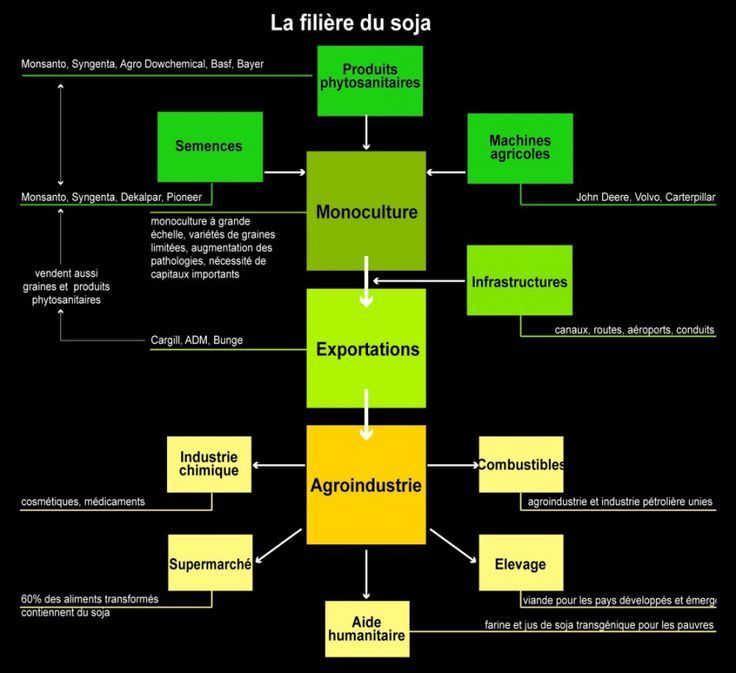
So we can see these big cargo ships waiting to receive the right soy at anchor off Santarém. Lunch break at a restaurant run by a renowned chef in Brazil, then it’s back towards the village with a last stop at a beautiful beach to watch the sunset. The landscapes are incredible, the beaches are paradise-like, the weather is excellent; in short, we are well here. A few days later, it’s Karimbo night! It’s a traditional dance typical of the Amazon. The women wear large colorful skirts and the men wear very nice white clothing. Everyone gathers for this weekly event to dance the Karimbo or, like me, to at least try some dance steps.
I had two wonderful weeks in this little corner of paradise. If it had been peak season, I would have stayed longer to work, but bad timing meant there weren’t many people during my visit. Maybe next time?
Anyway, I’m heading back to finish my crossing of the Amazon River! I’m boarding on Saturday the last boat that will take me to Macapá!
En savoir plus sur Les aventures de Cécé
Abonnez-vous pour recevoir les derniers articles par e-mail.

 Les aventures de Cécé